AI CRM Automation: Smarter Pipelines in 2026
AI CRM automation moves beyond basic lead scoring into intelligent pipeline management, deal coaching, and multi-agent workflows that transform how sales teams operate.
Key Takeaways
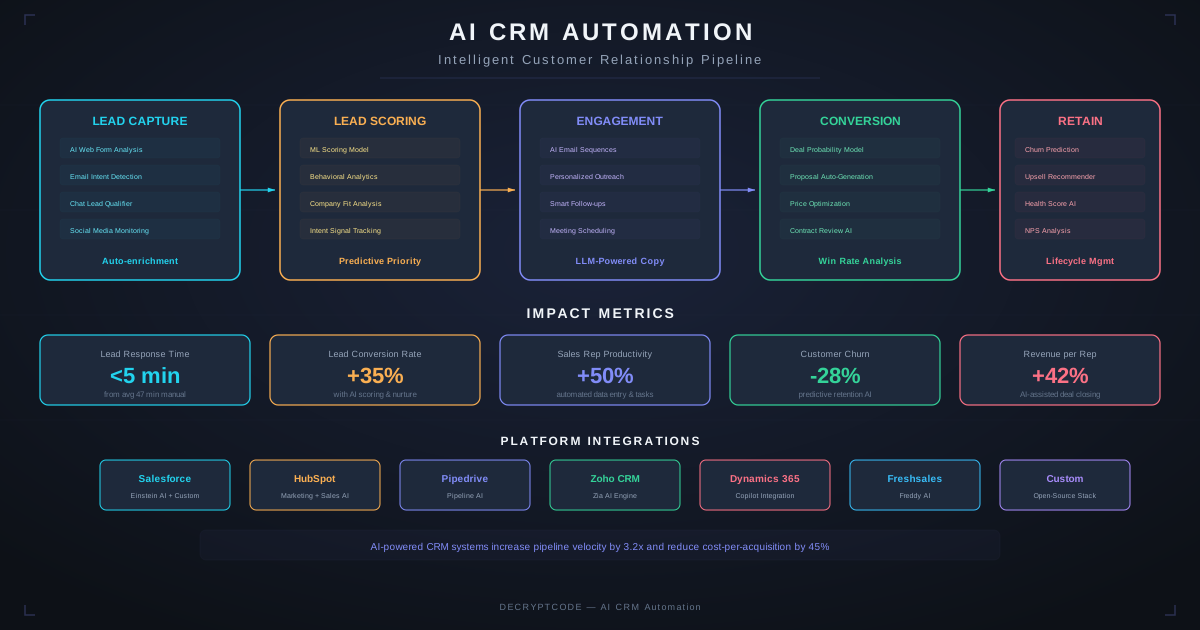
- AI lead scoring analyzes hundreds of signals vs. fixed rule-based points — 20-40% higher conversion rates
- Multi-agent CRM systems distribute tasks: lead enrichment, scoring, routing, follow-up, and forecasting
- AI deal coaching surfaces risk signals and next-best-actions based on historical win patterns
- ROI is typically 2-4 months: 30-50% reduction in sales admin time + improved conversion
- Start with lead scoring, expand to pipeline management, then deal intelligence
CRM Automation Evolution
CRM automation has evolved through three generations:
- Rules-Based (2010-2018): "If lead source = webinar AND job title contains VP, assign to enterprise team." Fixed rules, manual maintenance, no learning.
- ML-Assisted (2018-2024): Predictive lead scoring, basic pattern recognition. Black-box models that scored leads but couldn't explain why.
- Agent-Driven (2025+): Autonomous AI agents that research prospects, score leads with reasoning, route intelligently, draft personalized outreach, coach reps, and forecast deals — with full transparency.
The third generation, powered by LLMs and multi-agent orchestration, transforms CRM from a record-keeping system into an active sales intelligence platform.
AI Lead Scoring
Traditional lead scoring assigns fixed points to attributes (company size, title, page views). AI lead scoring analyzes hundreds of signals in combination:
- Behavioral patterns: Page visit sequences, content consumption depth, return frequency. A lead who reads 3 technical blog posts then visits pricing is more qualified than one who only downloads a whitepaper.
- Firmographic enrichment: Company size, growth rate, tech stack, funding stage, hiring signals. AI enriches sparse CRM data from external sources.
- Intent signals: Third-party intent data (G2, Bombora), job postings indicating technology adoption, competitive product reviews.
- Engagement quality: Not just "opened email" but sentiment in replies, question depth in chat, meeting scheduling behavior.
- Historical patterns: Which combinations of attributes predicted closed-won deals in the past? AI finds patterns humans miss.
Scoring Architecture
A modern AI scoring pipeline:
- Data Collection: Aggregate signals from CRM, marketing automation, website analytics, intent providers, and enrichment APIs
- Feature Engineering: Transform raw signals into predictive features (e.g., "pricing page visits in last 7 days," "email reply sentiment," "days since last activity")
- Model Inference: Gradient-boosted ensemble + LLM reasoning for explainable scores
- Score Delivery: Push 0-100 score + reasoning back to CRM via API, trigger routing workflows
Pipeline Intelligence
Beyond lead scoring, AI agents manage the entire pipeline:
- Automatic Data Capture: Parse meeting notes, call transcripts, and emails to update CRM fields — reps never manually enter data
- Stage Progression: Detect when deals are ready to advance based on completed actions (demo done, proposal sent, champion identified)
- Stagnation Detection: Flag deals stuck in a stage beyond the average duration. Surface "deals at risk" dashboards.
- Competitive Intelligence: Monitor mentions of competitors in conversations and enrich with competitive positioning
- Meeting Preparation: Before each meeting, generate a briefing: account history, stakeholder map, open issues, suggested talking points
Deal Coaching & Forecasting
AI analyzes historical win/loss patterns to coach reps and improve forecasting:
Deal Risk Scoring
- No multi-threaded engagement (single contact) → High risk
- Champion went silent for 14+ days → Escalation trigger
- Competitor mentioned in last meeting → Competitive play needed
- Legal/procurement not engaged by Stage 4 → Timeline risk
Next-Best-Action Recommendations
Based on similar deals that closed successfully:
- "Similar deals converted 3x better when a technical demo was scheduled before the proposal"
- "Deals at this stage with only one contact have 23% win rate. Suggest multi-threading."
- "Pricing discussion is overdue. Deals that address pricing before stage 4 close 40% faster."
AI Forecasting
Traditional forecasting relies on rep gut feel. AI forecasting combines:
- Historical close rates by stage, segment, and deal size
- Current deal health signals (engagement, velocity, risk factors)
- Macro patterns (seasonal trends, market conditions)
Result: 15-30% more accurate forecasts vs. human judgment alone.
Multi-Agent CRM Architecture
A LangGraph-based multi-agent system for CRM automation:
- Lead Enrichment Agent: Researches new leads via web search, LinkedIn, Clearbit/Apollo APIs. Fills in missing firmographic data.
- Scoring Agent: Applies ML scoring model + LLM reasoning. Outputs score + rationale ("82/100: Series B SaaS, VP Engineering, visited pricing 3x, tech stack includes competitor").
- Routing Agent: Assigns to the right rep based on territory, segment fit, and rep capacity. Handles round-robin with load balancing.
- Outreach Agent: Drafts personalized initial outreach based on lead research. Rep reviews and sends.
- Pipeline Agent: Monitors deal progression, updates CRM fields from meeting notes, flags stagnation.
- Forecasting Agent: Rolls up deal probabilities into team/org forecasts with confidence intervals.
Supervisor agent coordinates all specialist agents, manages state transitions, and escalates to humans when confidence is low. See our multi-agent CRM case study for a production implementation.
CRM Integration Patterns
| CRM | API | Best Approach |
|---|---|---|
| Salesforce | REST + SOAP + Streaming | Platform Events for real-time, REST for CRUD, Apex triggers for validation |
| HubSpot | v3 REST + Webhooks | Webhooks for events, REST for operations, custom properties for AI fields |
| Dynamics 365 | Dataverse Web API | Dataverse for CRUD, Power Automate for workflow integration |
| Pipedrive | REST + Webhooks | Webhooks for deal events, REST for pipeline management |
- Create custom fields in CRM for AI scores, reasoning, and agent actions
- Implement bidirectional sync — CRM changes trigger AI updates, AI actions update CRM
- Use webhook debouncing to prevent infinite update loops
Implementation Guide
- Phase 1 — Lead Scoring (Weeks 1-4): Connect to CRM API. Build scoring model on historical win/loss data. Deploy with shadow scoring (score but don't route). Validate accuracy.
- Phase 2 — Pipeline Automation (Weeks 5-8): Auto-capture from meeting notes and emails. Stage progression detection. Stagnation alerts. Rep adoption training.
- Phase 3 — Deal Intelligence (Weeks 9-12): Deal risk scoring. Next-best-action recommendations. AI forecasting. Management dashboards.
- Phase 4 — Multi-Agent Expansion (Weeks 13-16): Add enrichment, outreach drafting, and competitive intelligence agents. Continuous improvement loop.
Explore our AI workflow automation services to build AI-powered CRM pipelines.
Case Study: B2B SaaS Company
A B2B SaaS company (200-person sales team) deployed a multi-agent CRM automation system:
- Before: Manual lead scoring, 4+ hours/week per rep on data entry, 65% forecast accuracy
- After: AI scoring with 34% more pipeline-qualified leads, 50% less admin time, 89% forecast accuracy
- ROI: $1.2M incremental revenue in year 1
Full details: Multi-Agent CRM Pipeline Case Study.
Frequently Asked Questions
How does AI lead scoring differ from traditional scoring?
Traditional scoring uses fixed rules. AI analyzes hundreds of signals in combination, learns from historical outcomes, and provides explainable reasoning. Typically 20-40% better conversion rates.
Can AI CRM automation work with Salesforce and HubSpot?
Yes. AI agents connect via CRM APIs to read contacts, update deals, create tasks, and trigger workflows. Custom middleware handles data mapping and conflict resolution.
What's the ROI timeline?
Typically 2-4 months. Lead scoring shows results within weeks. Pipeline automation reduces admin time 30-50% immediately. Full deal intelligence takes 3-6 months for maximum impact.
Build Intelligent CRM Workflows
AI-powered lead scoring, pipeline management, and deal intelligence — from POC to production.
Start a Project