AI Integration in Production: Enterprise Deployment Guide
Moving AI from notebook to production is where most projects stall. This guide covers API design, infrastructure patterns, observability, rollback strategies, and the operational practices that separate POC demos from reliable enterprise systems.
Key Takeaways
- Production readiness takes 2-3x the model development time — plan for it
- Every AI call needs timeout handling, fallback logic, and error classification
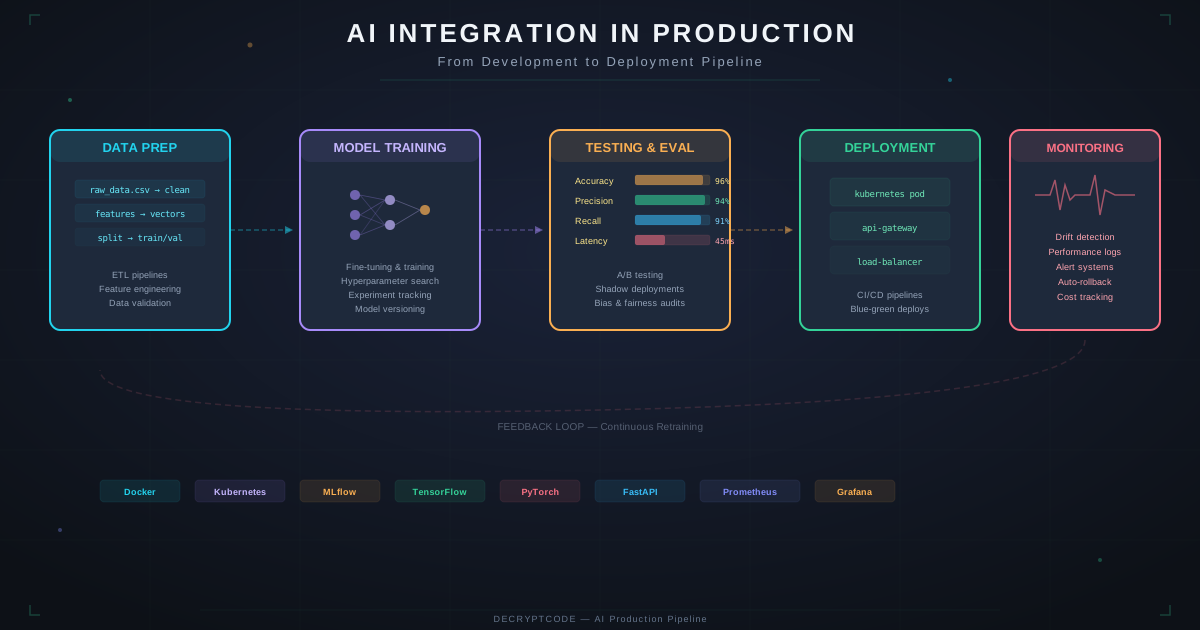
- Implement canary deployments — route 5% of traffic to new model versions before full rollout
- Monitor model-specific metrics: latency p95/p99, token usage, output quality scores, drift detection
- Hybrid cloud/self-hosted is the most common enterprise pattern in 2026
The POC-to-Production Gap
80% of AI projects never reach production. The reasons are rarely about model accuracy:
- Integration complexity: Connecting with legacy systems, handling data format mismatches, managing authentication across services
- Infrastructure gaps: GPU provisioning, scaling, latency requirements that notebooks don't reveal
- Operational readiness: No monitoring, no rollback plan, no on-call procedures, no runbooks
- Data quality: Training data was curated; production data is dirty, incomplete, and adversarial
- Edge cases: Input variations that never appeared in evaluation suites
The fix: treat production deployment as a first-class engineering discipline, not an afterthought. Budget 40-60% of project timeline for production hardening.
API Design for AI Services
Synchronous vs. Asynchronous
- Synchronous: Client waits for response. Use when latency < 5 seconds and result is immediately needed (classification, scoring, extraction).
- Asynchronous: Client submits job, polls for result or receives webhook callback. Use for long-running tasks (document processing, report generation, complex agent workflows).
API Contract Best Practices
- Version your APIs from day 1:
/v1/classify - Include request IDs for tracing across services
- Return confidence scores alongside predictions
- Include processing metadata (model version, latency, token count)
- Use structured error responses with error codes, not just HTTP status codes
- Document rate limits and quota policies upfront
Streaming for LLM Outputs
For generative outputs, use Server-Sent Events (SSE) to stream tokens as they're generated. This dramatically improves perceived latency — users see the first token in 200-500ms instead of waiting 5-30 seconds for the complete response.
Infrastructure Patterns
Cloud AI APIs
Using hosted APIs (OpenAI, Anthropic, Google): fastest path to production. Tradeoffs:
- Pros: Zero infrastructure management, automatic scaling, latest models, fast iteration
- Cons: Data leaves your VPC, per-token costs at scale, vendor dependency, rate limits
Self-Hosted Models
Running models on your infrastructure (vLLM, TGI, Ollama): full control. Use for data-sensitive workloads.
- Pros: Data stays in your VPC, predictable costs, no rate limits, model customization
- Cons: GPU procurement, operational complexity, model update lag, scaling requires planning
Hybrid Architecture (Recommended)
Most enterprises in 2026 use hybrid: cloud APIs for development/non-sensitive workloads, self-hosted for production-critical or regulated workloads. A model router selects the appropriate backend based on data sensitivity, latency requirements, and cost optimization.
Deployment Strategies
Blue-Green Deployment
Run two identical environments. Deploy new version to green while blue serves traffic. Switch traffic once validated. Instant rollback by switching back. Works well for model version updates.
Canary Deployment (Recommended)
Route a small percentage (1-5%) of traffic to the new model version. Monitor quality metrics. Gradually increase traffic if metrics are healthy. Automated rollback if metrics degrade.
Shadow Mode
Run the new model in parallel with the current model. Both process every request but only the current model's output is used. Compare outputs to validate the new model before any traffic switch. Essential for high-stakes applications.
Feature Flags
Wrap AI features in feature flags for granular control. Enable per-user, per-account, or per-region. Allows instant kill-switch if issues arise. Use LaunchDarkly, Unleash, or simple config-based flags.
Observability & Monitoring
AI systems need standard observability plus model-specific monitoring:
Standard Metrics
- Latency: p50, p95, p99 for every AI endpoint. Set SLAs and alert on violations.
- Error rate: 4xx (client errors), 5xx (server errors), model-specific failures
- Throughput: Requests per second, tokens per minute
- Resource utilization: GPU/CPU usage, memory, queue depth
AI-Specific Metrics
- Token usage: Prompt tokens, completion tokens, cost per request
- Output quality: Automated quality scoring, hallucination detection, format compliance
- Data drift: Input distribution shifts compared to training/baseline data
- Confidence distribution: Track model confidence scores over time — declining confidence signals model degradation
- Human override rate: How often do humans modify or reject AI outputs?
Alerting Strategy
- P1 (page): Error rate > 5%, p99 latency > SLA, total failure
- P2 (Slack alert): Confidence distribution shift, output quality drop, cost spike
- P3 (weekly review): Gradual drift trends, human override rate increase
Reliability Engineering
Fallback Cascade
Never let an AI failure crash the user experience. Implement cascading fallbacks:
- Primary model (e.g., Claude Sonnet) → 2. Fallback model (e.g., GPT-4o-mini) → 3. Rule-based logic → 4. Human escalation
Circuit Breakers
When an AI service fails repeatedly, stop calling it. Circuit breaker pattern:
- Closed: Normal operation, requests flow through
- Open: After N failures, stop calling. Route to fallback. Wait for cooldown.
- Half-open: After cooldown, try one request. If it succeeds, close the circuit. If it fails, re-open.
Timeout Handling
LLM calls can be slow or hang. Every AI call needs:
- Connection timeout: 5s (how long to establish connection)
- Response timeout: 30-120s (depends on task complexity)
- Total timeout: Cap the maximum total time including retries
- Streaming heartbeat: If streaming, detect stalls (no token for 10s)
Retry Strategy
Exponential backoff with jitter. Retry only on transient errors (rate limits, server errors). Never retry on validation errors or token limit exceeded.
Scaling Patterns
- Request queuing: Buffer bursts in message queues (SQS, RabbitMQ, Redis Streams). Workers process at sustainable throughput. Prevents overloading LLM providers.
- Semantic caching: Cache embeddings of previous queries. For similar questions (cosine similarity > 0.95), return cached responses. Reduces LLM calls 20-40% for repetitive workloads.
- Model routing: Route simple tasks to smaller/cheaper models, complex tasks to larger models. Classification-based routing reduces costs 40-60%.
- Batch processing: Group requests and process in batches for throughput-oriented workloads. Reduces per-request overhead.
- Horizontal scaling: For self-hosted models, scale GPU instances behind a load balancer. Use auto-scaling based on queue depth.
Security Considerations
- Input validation: Sanitize all inputs before passing to models. Prompt injection defense is essential.
- Output filtering: Scan AI outputs for PII, credentials, or prohibited content before returning to users
- Audit logging: Log every AI interaction (input, output, model version, user) for compliance and debugging. Redact sensitive data in logs.
- Network isolation: AI services in private subnets. No direct internet access unless needed for API calls.
- API key management: Rotate keys regularly. Use secrets managers (Vault, AWS Secrets Manager). Never embed keys in code.
Ready to deploy AI to production? Explore our AI workflow automation and enterprise AI consulting services.
Frequently Asked Questions
What's the biggest challenge in deploying AI to production?
The gap between POC accuracy and production reliability. Models that work in notebooks fail due to data drift, edge cases, latency requirements, and integration complexity. Budget 40-60% of project timeline for production hardening.
How do I handle AI model failures in production?
Implement a fallback cascade: primary model → fallback model → rule-based logic → human escalation. Circuit breakers prevent cascading failures. Every call needs timeout handling and error classification.
Cloud APIs or self-hosted models?
Most enterprises use hybrid: cloud APIs for development and non-sensitive workloads, self-hosted for data-sensitive or high-volume production workloads. A model router selects the appropriate backend.
Deploy AI to Production
Production-grade AI infrastructure, monitoring, and reliability engineering — from architecture to launch.
Start a Project