Claude vs OpenAI for Enterprise: 2026 Comparison
Anthropic's Claude and OpenAI's GPT-4 are the two dominant enterprise LLM providers. Here's how they compare on what actually matters — pricing, performance, safety, function calling, context windows, and deployment flexibility.
Key Takeaways
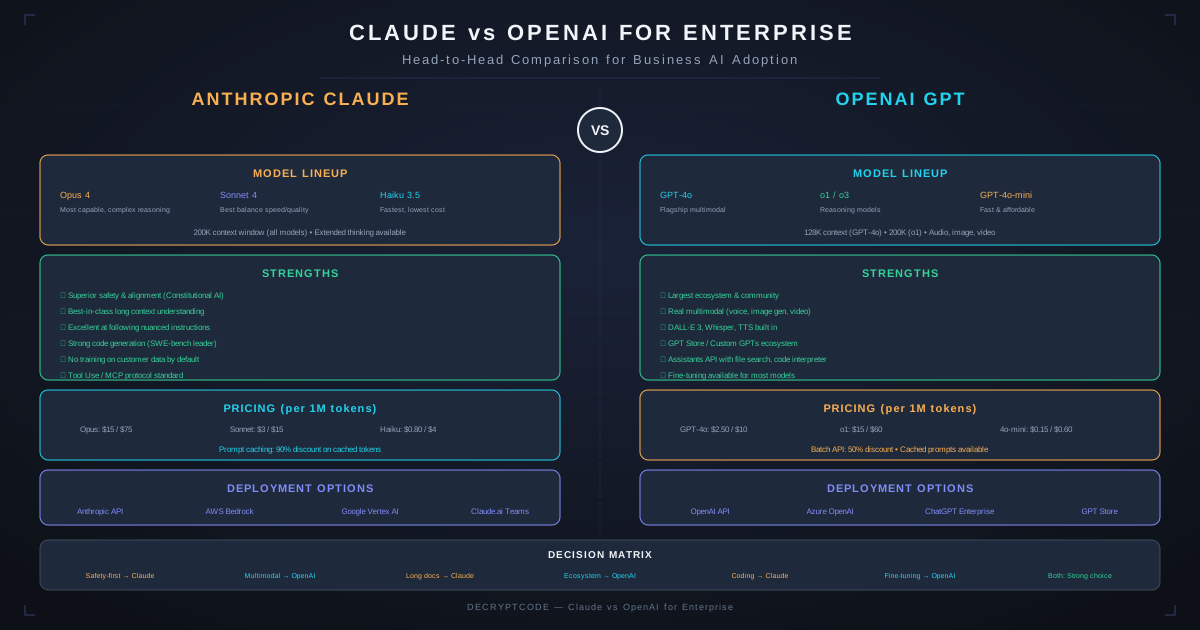
- Claude leads in long-context tasks (200K tokens), nuanced instruction following, and content safety
- GPT-4 leads in function calling reliability, fine-tuning, and ecosystem breadth
- Pricing is competitive — Claude Haiku and GPT-4o-mini are nearly identical for batch workloads
- Most enterprises should use both via a model-agnostic architecture with intelligent routing
- The model matters less than the engineering around it — invest in evaluation, guardrails, and monitoring
Model Lineup Overview
| Tier | Anthropic (Claude) | OpenAI (GPT) |
|---|---|---|
| Flagship | Claude 3.5 Opus | GPT-4o |
| Balanced | Claude 3.5 Sonnet | GPT-4o |
| Fast/Cheap | Claude 3.5 Haiku | GPT-4o-mini |
| Context Window | 200K tokens | 128K tokens |
| Fine-Tuning | Limited | Full support |
| Vision | Yes (all tiers) | Yes (all tiers) |
Performance Comparison
Based on public benchmarks and our production experience across 40+ enterprise deployments:
Reasoning & Analysis
Both models perform comparably on complex reasoning tasks. Claude tends to provide more nuanced, detailed analysis. GPT-4 is more concise and structured. For RAG applications, both achieve similar accuracy when properly configured.
Code Generation
GPT-4 maintains a slight edge in code generation across most languages. Claude performs better on code explanation and debugging. Both are production-capable for software engineering tasks.
Long-Form Content
Claude excels at long documents — its 200K context window handles full legal contracts, research papers, and regulatory filings without truncation. GPT-4's 128K window covers most use cases but may require chunking for very long documents.
Instruction Following
Claude follows complex, multi-constraint instructions more reliably in our testing. GPT-4 is more likely to take creative liberties. For enterprise applications where exact format compliance matters, Claude has an edge.
Pricing Comparison
| Model | Input / 1M tokens | Output / 1M tokens | Cost per Avg Query |
|---|---|---|---|
| Claude 3.5 Opus | $15.00 | $75.00 | $0.08-0.15 |
| Claude 3.5 Sonnet | $3.00 | $15.00 | $0.02-0.06 |
| Claude 3.5 Haiku | $0.25 | $1.25 | $0.001-0.005 |
| GPT-4o | $2.50 | $10.00 | $0.01-0.05 |
| GPT-4o-mini | $0.15 | $0.60 | $0.001-0.003 |
For high-volume workloads, both providers offer committed-use discounts (provisioned throughput for Anthropic, reserved capacity for OpenAI). At 1M+ queries/month, negotiate directly with both providers — listed prices are starting points.
Context Window & Long-Form
Claude: 200K tokens — approximately 150,000 words or 500 pages. Processes full legal contracts, comprehensive regulatory documents, and multi-document analysis in a single call.
GPT-4: 128K tokens — approximately 96,000 words or 320 pages. Handles most enterprise documents but may need chunking for very long inputs.
Practical impact: For document analysis and RAG applications, Claude's larger context window means you can include more retrieved context, improving answer quality for complex queries that span multiple documents.
Function Calling & Tools
Tool use is critical for AI agent development:
OpenAI: First-mover in native function calling. Highly reliable structured output via JSON mode. Parallel function calling for efficiency. Extensive documentation and ecosystem support. Most agent frameworks are optimized for OpenAI function calling first.
Claude: Tool use support has matured significantly. Supports parallel tool calls, native JSON output, and computer use capabilities. Stronger at reasoning about when NOT to use a tool — fewer unnecessary tool calls.
For production multi-agent systems, both work well. GPT-4 has a slight reliability edge for complex multi-tool scenarios, while Claude shows better judgment in avoiding unnecessary tool calls.
Safety & Guardrails
Anthropic's approach: Constitutional AI — the model is trained with a set of principles (a "constitution") that guide its behavior. Stronger default safety rails. Less likely to generate harmful content even without system prompt instructions. Better at refusing inappropriate requests while remaining helpful for legitimate use.
OpenAI's approach: More configurable safety through system prompts, fine-tuning, and content filtering APIs. More flexibility to adjust guardrail strictness. OpenAI Moderation API available as a separate layer.
For regulated industries (healthcare, financial services), Claude's constitutional AI approach provides a stronger baseline safety net. For use cases needing flexible content controls, OpenAI offers more tunability.
Enterprise Features Comparison
| Feature | Claude (Anthropic) | GPT-4 (OpenAI) |
|---|---|---|
| SOC 2 Type II | Yes | Yes |
| HIPAA BAA | Yes | Yes |
| SSO / SAML | Yes | Yes |
| Data Retention | 0-day (no training) | 0-day (API, no training) |
| Fine-Tuning | Limited availability | Full support (GPT-4o) |
| Batch API | Yes (50% discount) | Yes (50% discount) |
| Provisioned Throughput | Yes | Yes |
| AWS Marketplace | Yes (Bedrock) | Yes (Azure OpenAI) |
| Self-Hosting | No | No (Azure private) |
Use Case Recommendations
| Use Case | Recommended | Why |
|---|---|---|
| Document analysis (long) | Claude | 200K context, strong instruction following |
| AI agents with many tools | GPT-4 | More reliable function calling |
| Content generation | Claude | More nuanced, better at tone matching |
| Code operations | GPT-4 | Slightly better code generation |
| Customer-facing chat | Claude | Stronger safety guardrails by default |
| Data extraction | Either | Both excellent with structured output |
| RAG systems | Either | Both perform well; Claude for longer context |
| Compliance/regulated | Claude | Constitutional AI, conservative defaults |
Multi-Model Architecture
The best enterprise strategy: don't choose one — use both via an intelligent routing layer:
- Abstraction layer: Build a model-agnostic interface. Your application code shouldn't know or care which model is running. Use LiteLLM or a custom router.
- Intelligent routing: Classify queries by type (document analysis → Claude, function calling → GPT-4, simple queries → cheapest available).
- Failover: If one provider has an outage, automatically route to the other. Eliminate single-provider risk.
- Cost optimization: Route to the cheapest model that meets quality requirements for each query type.
- A/B testing: Run both models on the same queries, compare quality and cost, continuously optimize routing.
Need help choosing or implementing? Our AI consulting team designs multi-model architectures.
Frequently Asked Questions
Which is better for enterprise?
It depends on your use case. Claude excels at long-context tasks, safety, and instruction following. GPT-4 leads in function calling, ecosystem, and fine-tuning. Most enterprises use both with intelligent routing.
Is Claude more secure than OpenAI?
Both offer enterprise-grade security (SOC 2, BAA). Claude's constitutional AI provides stronger default safety. OpenAI offers more controllability. The "safer" choice depends on your compliance requirements.
Can I switch between them easily?
Yes, with an abstraction layer. Both support compatible API formats. Frameworks like LangChain and LiteLLM make multi-model architectures straightforward. Build model-agnostic from the start.
Build a Model-Agnostic AI Architecture
We design multi-model systems that optimize for cost, quality, and reliability across providers.
Start a Project