HIPAA-Compliant AI Deployment: Complete Guide
Healthcare AI systems that handle PHI (Protected Health Information) must comply with HIPAA's Privacy, Security, and Breach Notification Rules. This guide covers the technical and administrative controls needed to deploy LLMs, RAG systems, and AI agents in healthcare without violations.
Key Takeaways
- HIPAA applies to AI systems the same way it applies to any system handling PHI — no special exemptions
- Sign BAAs with every AI vendor that touches PHI (cloud LLM providers, vector DB hosting, etc.)
- De-identify PHI before sending to LLMs when possible — avoid the compliance burden entirely
- Self-hosted models in your VPC give maximum PHI control but increase operational complexity
- Audit logging for every AI interaction involving PHI is mandatory, not optional
HIPAA & AI Overview
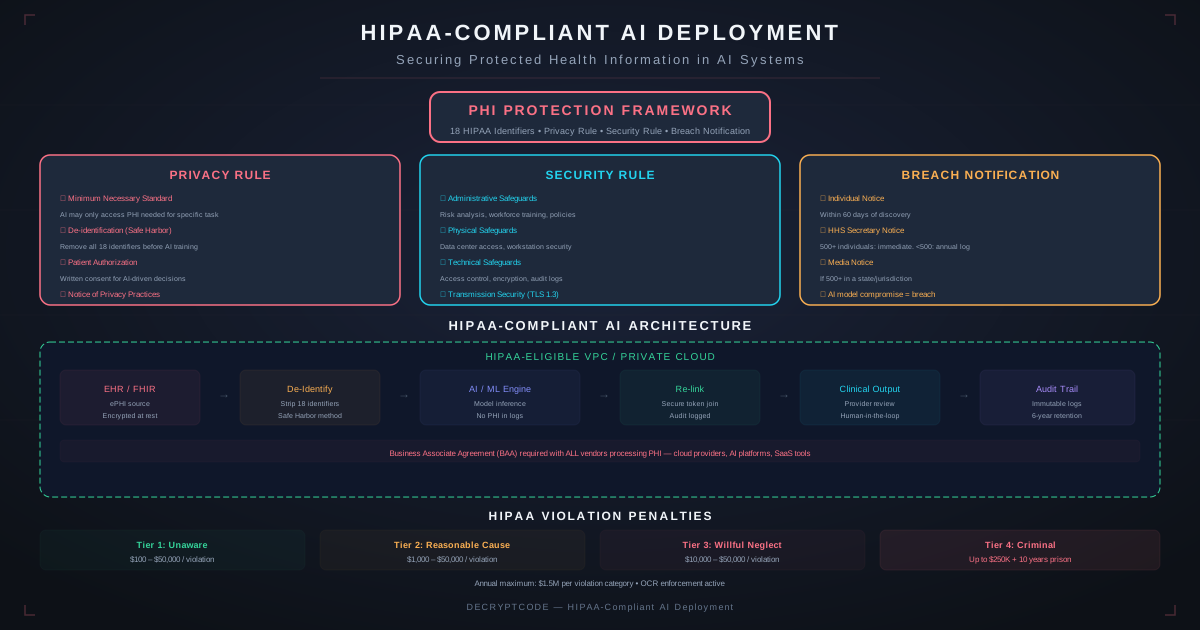
HIPAA (Health Insurance Portability and Accountability Act) governs how Protected Health Information is used and disclosed. When AI systems process PHI, every component in the data flow must comply with three rules:
- Privacy Rule: Controls who can access PHI and how it can be used. AI systems must enforce minimum necessary access — only the PHI needed for the specific function.
- Security Rule: Requires technical, physical, and administrative safeguards. This includes encryption, access controls, audit logs, and incident response procedures.
- Breach Notification Rule: If AI system failures or security incidents expose PHI, notification requirements activate — individuals within 60 days, HHS, and potentially media.
Critical point: HIPAA doesn't have AI-specific regulations (as of 2026). AI systems must meet the same standards as any system handling PHI. The technology is different; the compliance requirements are not.
PHI in AI Systems
PHI includes any individually identifiable health information. In AI systems, PHI appears in:
- Training data: If you fine-tune models on patient records, clinical notes, or claims data
- Prompts (LLM inputs): When user queries include patient names, MRNs, diagnoses, or other identifiers
- Context (RAG retrieval): When retrieved documents contain PHI that gets injected into LLM prompts
- Outputs: When AI generates text that includes or reveals PHI
- Embeddings: Vector representations of PHI documents in vector databases
- Logs: System logs that capture inputs/outputs containing PHI
De-Identification Strategy
The most effective compliance strategy: de-identify PHI before it enters the AI pipeline. HIPAA defines two methods:
- Safe Harbor: Remove 18 identifier categories (names, dates, locations, SSN, MRN, etc.). Use NER models to detect and mask identifiers.
- Expert Determination: A qualified statistician certifies that the risk of re-identification is very small. More flexible but requires expert engagement.
De-identification lets you use standard LLM APIs without BAAs and dramatically simplifies compliance. But it's not always possible — some use cases require AI to work with identified PHI (e.g., patient-facing portals, clinical decision support referencing specific patients).
Compliant Architecture
Design your AI system architecture to minimize PHI exposure:
- PHI Gateway: Single entry point that validates, encrypts, and logs all PHI access. De-identifies where possible before forwarding to AI services.
- AI Processing Layer: Self-hosted models in private subnets (preferred) or HIPAA-eligible cloud APIs with signed BAAs.
- Vector Database: Self-hosted (Qdrant, Milvus, pgvector) in your VPC with encryption at rest. Row-level security for multi-tenant access control.
- Audit Layer: Immutable audit logs of every PHI access, AI query, and output. Write-once storage (S3 Object Lock, WORM).
- Output Filter: Scan AI outputs before returning to users — ensure no unauthorized PHI disclosure.
See our healthcare AI solutions for compliant architecture implementations.
Encryption Requirements
| Data State | Requirement | Implementation |
|---|---|---|
| In transit | TLS 1.2+ (required) | TLS 1.3 for all API calls, internal service-to-service mTLS |
| At rest | AES-256 (addressable) | Database encryption, file system encryption, vector DB encryption |
| In memory | Minimize exposure | Process PHI in secure enclaves (AWS Nitro, Azure Confidential), clear after use |
| In logs | Redact or encrypt | PHI-aware log sanitization, encrypted log storage |
| In backups | Same as at rest | Encrypted backups, retention policies, secure destruction |
Key management: Use HSM-backed key management (AWS KMS, Azure Key Vault, HashiCorp Vault). Rotate encryption keys annually. Separate keys for different data classifications.
Business Associate Agreements
Any vendor that creates, receives, maintains, or transmits PHI on your behalf is a Business Associate. You need BAAs with:
- Cloud providers: AWS (HIPAA-eligible services), Azure, GCP all offer BAAs
- LLM providers: OpenAI (API tier), Anthropic (API tier) offer BAAs — verify current status
- Vector DB hosting: Pinecone (Enterprise), Weaviate Cloud — check BAA availability
- Monitoring/logging: Datadog, Splunk, New Relic — most enterprise tiers offer BAAs
- AI development contractors: Any external team building or maintaining the AI system
No BAA = no PHI. If a vendor won't sign a BAA, you cannot send them identifiable PHI. Period.
Access Controls
- Role-Based Access Control (RBAC): Define roles (physician, nurse, admin, AI system) with minimum necessary permissions
- Row-Level Security: In RAG systems, filter retrieved documents based on user's access rights. A nurse sees only their assigned patients' data.
- Unique User Identification: Every AI interaction logged with authenticated user identity. No shared service accounts for PHI access.
- Automatic Logoff: Session timeouts for AI-powered applications (15 minutes typical for healthcare)
- Emergency Access: Break-the-glass procedures for emergency PHI access with post-hoc review
Audit & Logging
HIPAA requires audit controls that record and examine activity in systems containing PHI:
- What to log: Who accessed PHI, what PHI was accessed, when, from where, what action was taken, what AI model processed it, what output was generated
- Retention: HIPAA requires 6 years minimum for policies/procedures. Best practice: retain audit logs 7 years.
- Integrity: Logs must be tamper-evident. Use write-once storage, cryptographic hashing, or blockchain-based audit trails.
- Regular review: Monthly automated scans for anomalous access patterns. Quarterly manual reviews by compliance team.
LLM-Specific Considerations
Model Training on PHI
If fine-tuning models on clinical data: use de-identified data whenever possible. If identified PHI is required, train only on self-hosted infrastructure with full encryption and access controls. Verify that models don't memorize and regurgitate PHI in outputs.
Prompt Injection & PHI
Prompt injection attacks in healthcare could trick AI into revealing other patients' PHI. Implement input sanitization, output filtering, and permission boundaries to prevent cross-patient information leakage.
RAG with Clinical Documents
When building RAG systems over clinical data:
- Implement document-level access control in the vector database
- Filter retrieved documents by patient context before injecting into prompts
- Limit retrieved document counts to minimize PHI exposure in context windows
- Log all retrievals with document IDs and patient identifiers for audit
AI-Assisted Clinical Decisions
AI outputs that inform clinical decisions require additional safeguards:
- Clear labeling: "AI-generated suggestion — clinical judgment required"
- Confidence scores and evidence citations
- Human-in-the-loop approval for treatment-affecting recommendations
- Documentation of AI's role in clinical decision for medical records
See our healthcare AI case study for a HIPAA-compliant implementation.
HIPAA AI Deployment Checklist
- ☐ PHI data flow mapped for entire AI pipeline
- ☐ BAAs signed with all vendors touching PHI
- ☐ De-identification applied where possible (before AI processing)
- ☐ Encryption at rest (AES-256) and in transit (TLS 1.3)
- ☐ RBAC + row-level security implemented
- ☐ Audit logging for all PHI access and AI interactions
- ☐ Output filtering to prevent unauthorized PHI disclosure
- ☐ Incident response plan includes AI-specific scenarios
- ☐ Annual risk assessment updated for AI systems
- ☐ Staff training on AI-specific PHI handling
- ☐ Prompt injection defenses deployed
- ☐ Data retention and destruction policies applied to AI data stores
Need help with HIPAA-compliant AI? Explore our healthcare AI development services.
Frequently Asked Questions
Can I use OpenAI or Claude APIs with PHI?
Both offer HIPAA-eligible API tiers with BAAs. Use enterprise/API plans, sign a BAA, and ensure TLS encryption. Many healthcare organizations prefer self-hosted models for maximum PHI control.
What are the penalties for HIPAA violations involving AI?
Same penalties as any HIPAA violation: $100 to $50K per violation depending on tier, up to $1.5M annual maximum per category. Criminal penalties include fines up to $250K and imprisonment.
How do I handle PHI in vector databases for RAG?
Encrypt vectors at rest and in transit. Implement row-level security. De-identify before embedding when possible. Use self-hosted vector databases in your VPC. Log all queries for audit trails.
Build HIPAA-Compliant AI
From architecture design to deployment — our team builds healthcare AI that passes compliance audits.
Start a Project