
Mobile Security in the AI Era: Threats, Defenses & Best Practices
AI is transforming how mobile apps are attacked and defended. From deepfake biometric spoofing to prompt injection in AI features, here's what security teams need to know in 2026.
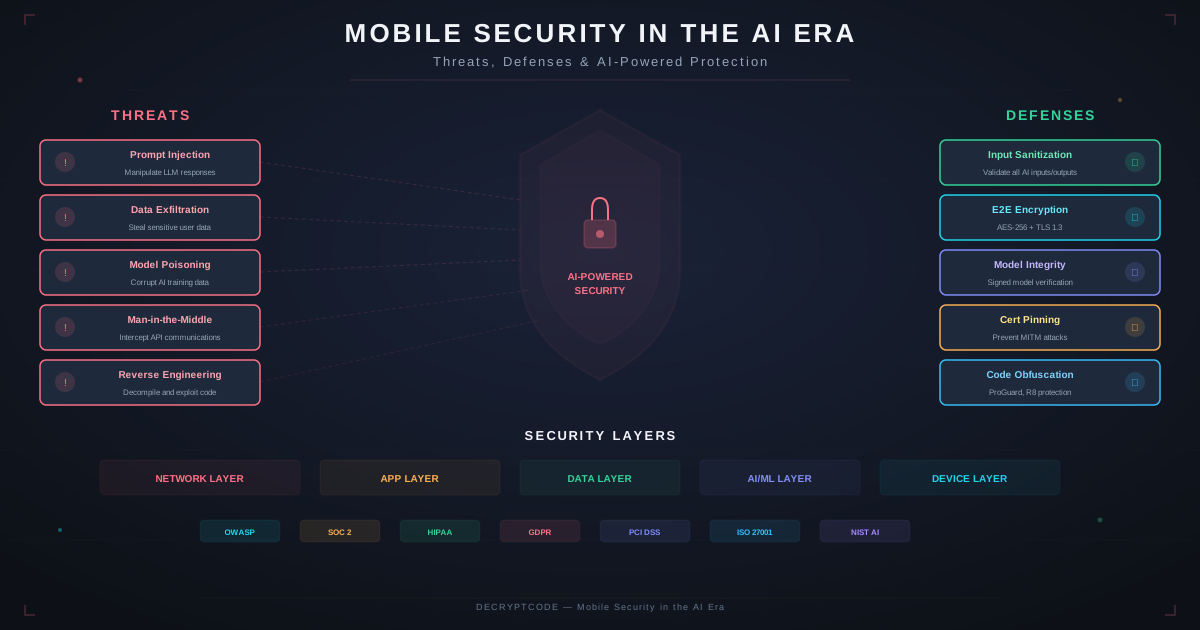
Key Takeaways
- AI-powered attacks (deepfakes, automated vuln discovery, smart phishing) require AI-powered defenses
- In-app AI features create new attack surfaces — prompt injection, data exfiltration, model theft
- Behavioral biometrics and continuous authentication replace single-point verification
- Supply chain attacks through compromised SDKs are the fastest-growing mobile threat vector
- Security must be adaptive and continuous — not a one-time audit
Threat Landscape 2026
The mobile security landscape has fundamentally shifted. Attacks are more sophisticated, automated, and personalized thanks to AI. At the same time, mobile apps contain more sensitive data and perform more critical functions than ever.
| Threat Category | 2024 State | 2026 State | Impact Level |
|---|---|---|---|
| Credential attacks | Password stuffing | AI-generated spear phishing + deepfake voice | Critical |
| Biometric spoofing | Photo/video replay | Real-time deepfake face generation | High |
| App reverse engineering | Manual decompilation | AI-assisted code analysis + auto-exploit | High |
| Data exfiltration | Network interception | Prompt injection via AI features | Critical |
| Supply chain attacks | Occasional SDK compromise | Systematic dependency poisoning | Critical |
| On-device model attacks | Rare | Model extraction, adversarial inputs | Medium |
AI-Powered Threats
1. Deepfake Biometric Attacks
Generative AI can now produce real-time deepfake video that defeats basic facial recognition. Attackers use photos from social media to generate convincing face videos that pass liveness detection in banking and identity verification apps.
2. Automated Vulnerability Discovery
LLMs trained on vulnerability databases can analyze decompiled mobile app code and identify potential exploits in minutes rather than days. Tools like AI-assisted fuzzers generate targeted test cases based on the app's specific code patterns.
3. AI-Generated Phishing
LLMs craft phishing messages that match the target app's exact tone, branding, and notification patterns. Push notification spoofing is particularly effective — users trust notifications from apps they use daily.
4. Adversarial Attacks on On-Device Models
If your app uses on-device AI (image classification, fraud detection), attackers can craft inputs that cause misclassification. A slightly modified check image could bypass fraud detection. A manipulated document could pass identity verification.
AI-Powered Defenses
Behavioral Biometrics
Instead of single-point authentication, continuously verify identity through behavior patterns:
- Typing dynamics: Keystroke timing, pressure, error patterns
- Touch patterns: Scroll velocity, tap pressure, gesture style
- Device handling: Accelerometer and gyroscope patterns while holding phone
- Usage patterns: Typical app usage times, navigation flows, feature access patterns
Anomaly Detection
On-device ML models that detect:
- Unusual transaction patterns (amount, frequency, recipient)
- Jailbreak/root detection evasion attempts
- Automated bot behavior (too-consistent timing, no natural pauses)
- Network anomalies (unexpected DNS, unusual certificate chains)
AI-Assisted Security Testing
Use AI to strengthen your security posture:
- Automated penetration testing: AI agents that probe APIs, test authentication flows, and find logic vulnerabilities.
- Code analysis: LLM-powered static analysis that understands business logic, not just pattern matching.
- Threat modeling: AI that generates threat models based on app architecture and data flows.
Prompt Injection in Mobile Apps
As mobile apps add AI assistants, chatbots, and agent features, prompt injection becomes a critical risk. See our AI agent security guide for comprehensive coverage.
Mobile-Specific Risks
- Data access: Mobile AI assistants often have access to contacts, messages, calendar — prompt injection could exfiltrate this data.
- Action execution: AI agents that can make purchases, send messages, or modify settings can be weaponized through prompt injection.
- Context pollution: Crafted content in emails, messages, or documents that the AI reads could contain hidden instructions.
Defenses
- Input sanitization: Filter and validate all user inputs before passing to LLM. Strip known injection patterns.
- Output filtering: Validate AI responses before executing actions or displaying to users.
- Least privilege: AI features should have minimal access to device data and app functions. Require explicit user confirmation for sensitive actions.
- Monitoring: Log all AI interactions. Flag unusual patterns (excessive data requests, attempts to access unauthorized features).
Biometric Security
Current Biometric Defenses
| Defense Layer | Technology | Defeats |
|---|---|---|
| Passive liveness | Texture analysis, reflection detection | Photo replay, printed masks |
| Active liveness | Blink, smile, head turn challenges | Static deepfakes, video replay |
| 3D depth sensing | Structured light (Face ID), ToF | 2D deepfakes, screen display |
| Injection detection | Camera tampering checks, virtual camera detection | Video injection attacks |
| Behavioral layer | Device handling patterns during scan | Automated spoofing attempts |
Multi-layer biometric security is essential. No single defense is sufficient against AI-powered attacks.
Supply Chain Security
Mobile apps typically include 30-100+ third-party SDKs. Each is a potential attack vector.
- SDK audit: Review every SDK's permissions, network calls, and data collection before integration. Use tools like Exodus Privacy for Android.
- Dependency pinning: Lock dependency versions. Never auto-update SDKs in production without testing.
- SBOM (Software Bill of Materials): Maintain a complete inventory of all dependencies with versions and known vulnerabilities.
- Binary analysis: Scan SDK binaries for obfuscated code, hidden network calls, and suspicious behaviors.
- Runtime monitoring: Detect unexpected SDK behavior after deployment — new network endpoints, increased data collection.
See our app store privacy compliance guide for privacy-specific SDK requirements.
Enterprise Mobile Security Checklist
Authentication & Authorization
- Multi-factor authentication with hardware-backed biometrics
- Certificate pinning for all API communication
- Session timeout and re-authentication for sensitive operations
- Role-based access control with server-side enforcement
Data Protection
- Encryption at rest (AES-256, hardware-backed keystore)
- Encryption in transit (TLS 1.3, certificate pinning)
- No sensitive data in logs, crash reports, or analytics
- Secure data wiping on logout/remote wipe
App Hardening
- Code obfuscation (ProGuard/R8 for Android, bitcode for iOS)
- Jailbreak/root detection with response actions
- Debugger detection and anti-tampering
- Screenshot/screen recording prevention for sensitive screens
AI Feature Security
- Prompt injection protection with input/output validation
- On-device model encryption and integrity verification
- Rate limiting for AI API calls
- Audit logging for all AI-initiated actions
Frequently Asked Questions
How does AI change mobile app security?
AI introduces new attack vectors (deepfakes, automated exploits, prompt injection) and new defenses (behavioral biometrics, anomaly detection, AI-assisted testing). Security must be more adaptive and continuous.
What is prompt injection in mobile apps?
Attackers craft inputs that override AI system prompts, potentially exfiltrating data or triggering unauthorized actions. Defenses include input sanitization, output filtering, and least-privilege access.
What are the top mobile security threats in 2026?
AI-powered deepfakes against biometrics, prompt injection in AI features, supply chain attacks via compromised SDKs, credential stuffing with AI phishing, and adversarial attacks on edge AI models.
Secure Your Mobile App
Security assessments, architecture reviews, and hardening for enterprise mobile applications.
Request a Security Review