
Case Study · Insurance
AI Insurance Claims Processing
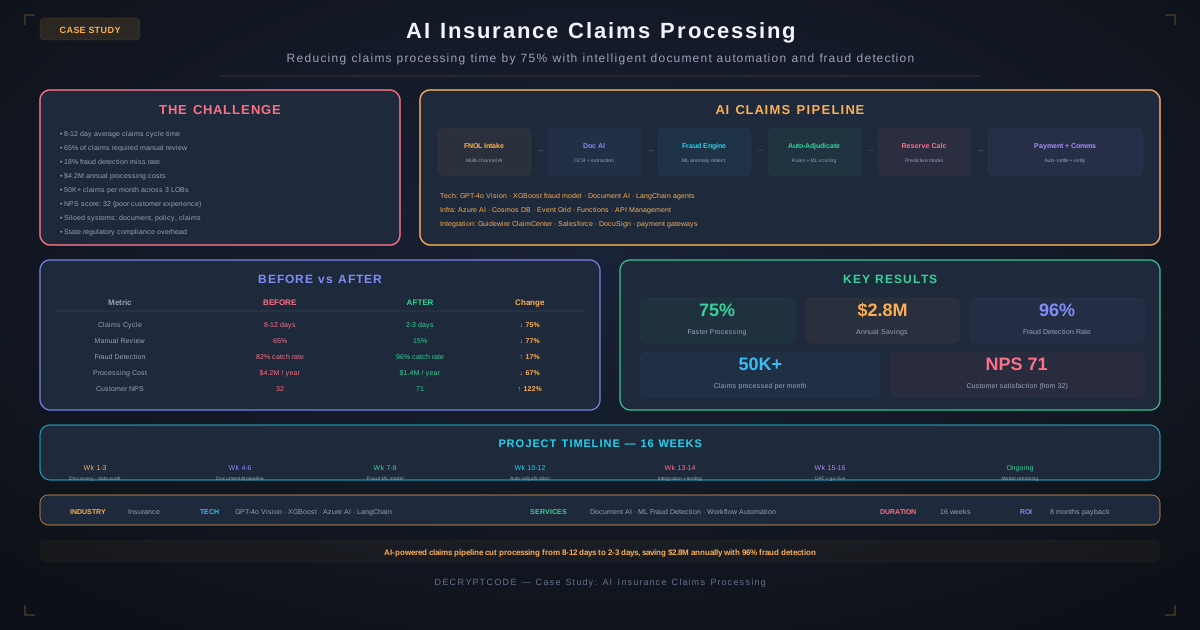
Multi-modal AI claims pipeline for a mid-size regional P&C insurer — vision transformers for damage assessment, NLP for classification, and XGBoost for fraud scoring. Processing reduced from 11 days to 3.5 days.
The Problem
Claims processing averaged 11 days. More than half of claims required manual review because documentation was inconsistent. Customer satisfaction was slipping, and operating costs per claim averaged $118. The carrier needed faster turnaround without adding adjuster headcount.
The Dataset
185K historical claims records, 72K supporting documents (photos, police reports, repair estimates), 14K adjuster notes, and weather/event correlation data. The data covered auto and property lines of business across 12 Midwest and Southeast states.
Model & Approach
- Vision Transformer: Fine-tuned for damage assessment from claim photos—severity estimation, damage type classification, and repair cost prediction.
- Fine-tuned BERT: Claims narrative classification—routing claims to the right department based on loss description text.
- XGBoost: Real-time fraud scoring using 200+ features including claim patterns, provider history, and timing anomalies.
- GPT-4: Adjuster recommendation generation—summarizing claim details and suggesting next steps for complex files.
Architecture
Event-driven microservices: claim intake → document classification → entity extraction → damage assessment → fraud screening → routing engine → adjuster dashboard. Real-time scoring with sub-second latency for straight-through processing decisions.
Apache Kafka for event streaming ensures no claim is lost in transit. Each stage publishes results to the next stage's topic, with dead-letter topics for failures requiring manual intervention.
Deployment
AWS: EKS for container orchestration, PostgreSQL for claims data, managed vision APIs for damage assessment, Kafka for event streaming, Grafana + Prometheus for monitoring. Blue-green deployments for zero-downtime model updates.
Results
Business Impact
$1.1M annual savings across 52K claims/year—primarily from adjuster time reclaimed, fewer re-inspections, and faster cycle times. Customer NPS increased 12 points. Fraud detection rate improved 22%, surfacing repeat-provider patterns the previous rules engine missed.
Why It Was Hard
Multi-modal data alignment was the core challenge—combining text narratives, damage photos, structured claim records, and temporal patterns into a unified scoring model. Fraud detection needed to balance sensitivity vs. false positives: wrongly flagging legitimate claims destroys customer trust faster than missing occasional fraud.
State-by-state regulatory variations required a configurable rule engine—claims handling timelines, required disclosures, and settlement procedures differ by jurisdiction.
What We Learned
Straight-through processing should start with the simplest, most predictable claim types and expand gradually. We launched with simple windshield claims (high volume, low complexity), proved the system's accuracy, then expanded to collision and property damage.
The hardest part isn't the AI—it's change management with adjusters who fear automation. Involving adjusters in the design process and positioning AI as "handling the boring claims so you can focus on complex ones" was critical for adoption.
FAQ
Does AI replace claims adjusters?
No. AI handles routine claims through straight-through processing and assists adjusters with complex cases by pre-populating assessments and generating recommendations. Adjusters make all final decisions.
How does it handle fraud?
Multi-signal fraud scoring with explainable flags. Suspicious claims are flagged for human SIU investigators. Humans make all final fraud determinations.
What about state regulatory differences?
Configurable rule engine per jurisdiction. State-specific requirements are configuration, not code—adapting as regulations change without redeployment.
Have aSimilarChallenge?
Tell us about your insurance AI project. We'll design a solution with clear ROI projections.