
Predictive Maintenance IoT
Edge-cloud AI system for a manufacturer with 40+ facilities and 12,000+ pieces of equipment. Time-series transformer models predict failures 7–14 days out. Unplanned downtime cut by 67%.
The Problem
A Fortune 500 manufacturer operating 40+ facilities with 12,000+ pieces of equipment was losing $27M annually to unplanned downtime. Maintenance was largely reactive—equipment ran until failure. Existing scheduled maintenance replaced parts on calendar intervals regardless of actual condition, wasting $8M/year in unnecessary part replacements.
The Dataset
2 years of sensor data from 12,000+ machines: vibration (accelerometer), temperature, pressure, power consumption, and acoustic signals. 480B data points total. 2,400 documented failure events with root cause analysis. Maintenance logs, part replacement records, and environmental conditions (humidity, ambient temperature).
Model & Approach
- Time-Series Transformer: Adapted Temporal Fusion Transformer (TFT) architecture for multi-variate sensor streams. Self-attention captures long-range dependencies across sensor channels. Each equipment type has a specialized model head.
- Edge Models: Distilled lightweight models (TFLite) running on NVIDIA Jetson edge gateways for real-time anomaly detection with 200ms latency. Only anomalies are sent to cloud for full transformer analysis.
- Remaining Useful Life (RUL): Regression head predicting days-to-failure with confidence intervals. Calibrated using Conformal Prediction for reliable uncertainty estimates.
- Root Cause Classifier: Multi-label classification identifying the probable failure component (bearing, motor, hydraulic seal, electrical) for targeted maintenance dispatch.
Architecture
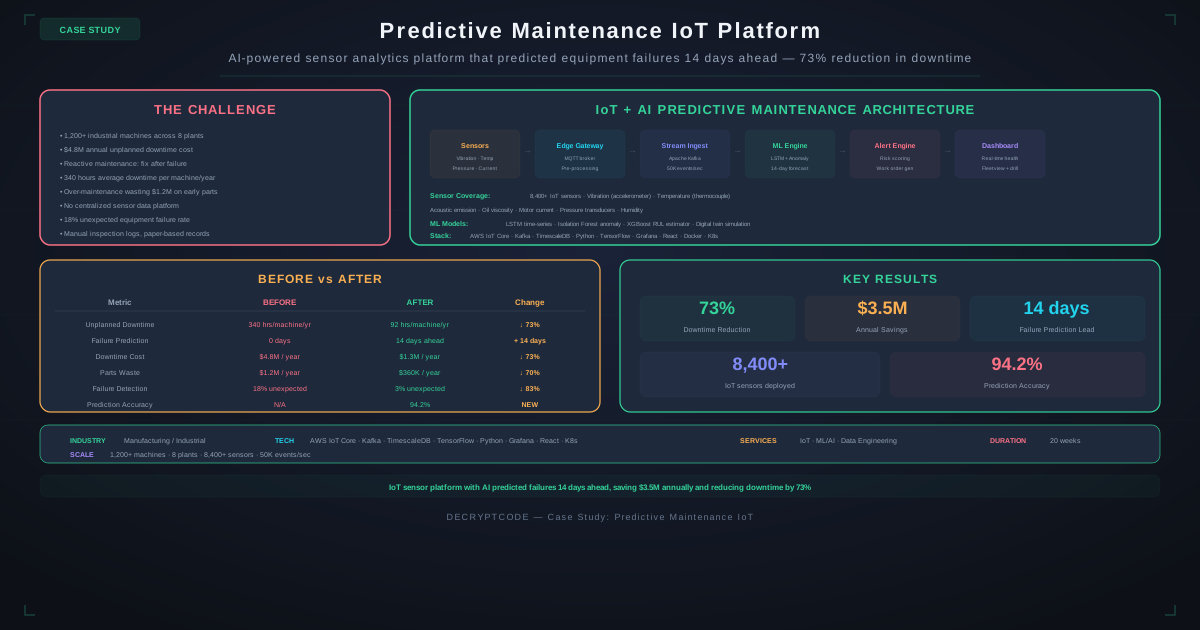
Edge gateways (Jetson Orin Nano) at each facility → anomaly pre-filter → cloud aggregation (AWS IoT Core) → feature pipeline (Apache Flink) → Transformer inference cluster → CMMS integration (SAP PM) → mobile technician alerts. Bi-directional model updates: cloud-trained models pushed to edge; edge inference results fed back for continuous learning.
Deployment
Phased rollout: 3 pilot facilities → 15 high-value facilities → all 40+. Edge gateways retrofitted to existing sensor infrastructure (Modbus, OPC-UA, MQTT). Cloud infrastructure on AWS with IoT Core, SageMaker for training, and ECS for inference. SAP PM integration for automated work order creation. Mobile app for technician alerts and failure probability dashboards.
Results
ROI
$18.4M annual savings. $14.2M from reduced unplanned downtime + $4.2M from optimized part replacement scheduling. ROI payback period: 8 months. Additional benefits: 23% longer average equipment lifespan, 15% reduction in maintenance labor costs.
Why It Was Hard
Sensor heterogeneity was the biggest challenge. 40+ facilities with equipment from 8 manufacturers, each with different sensor types, sampling rates, and data formats. The edge gateway normalization layer took 10 weeks to build.
Failure events are rare and expensive—you can't generate training data by breaking machines. Transfer learning from similar equipment types and synthetic failure simulation filled the data gap for new equipment classes.
What We Learned
Edge pre-filtering is essential at scale. Sending raw sensor data from 12,000 machines to the cloud costs more than the AI savings. Edge anomaly detection reduces data transfer by 94% while catching all significant events.
Maintenance technicians are the true end users, not data scientists. The mobile app with plain-language alerts ("Bearing 3 on CNC-4721 has 8 days of useful life remaining — order part #XYZ") drove adoption far more than dashboards.
FAQ
What equipment types does this monitor?
CNC machines, hydraulic presses, conveyor systems, and HVAC. New equipment types can be added within 4–6 weeks of sensor data collection.
How far ahead can it predict failures?
7–14 days for gradual degradation (bearing wear, motor issues). 2–4 hours for sudden-onset failures (electrical faults, coolant leaks).
Does this require new sensors?
No. We integrated with existing Modbus, OPC-UA, and MQTT sensors. Edge gateways normalize heterogeneous protocols into a unified format.