Case Study · Fintech
RAG-Powered Compliance Review System
How we built a hybrid RAG system that reduced regulatory compliance review time by 78% for a mid-size financial services firm — processing 2,800+ documents with citation-grounded answers.
The Problem
The legal and compliance team at a mid-size regional financial services firm manually reviewed 180+ regulatory documents per quarter. Average review time: 3.4 hours per document. Compliance analysts cross-referenced SEC filings, FINRA guidelines, and internal policies manually—a tedious, error-prone process.
Critical compliance gaps were being missed. Over 18 months, the firm incurred $420K in regulatory fines from overlooked policy conflicts. The eight-person compliance team couldn't scale with the increasing volume of regulatory updates.
The Dataset
2,800+ regulatory documents including SEC filings, FINRA guidelines, state-level regulations, and internal policy documents. 120 historical audit reports provided ground truth for relevance training. 45 compliance violation records helped fine-tune the system's understanding of what constitutes a real compliance gap versus a false alarm.
Model & Approach
We built a hybrid RAG architecture combining dense and sparse retrieval:
- Dense retriever: Fine-tuned BGE-Large embeddings on compliance-specific text, capturing semantic similarity for regulatory language.
- Sparse retriever: BM25 on Elasticsearch for exact terminology matching—critical when specific regulation numbers or clause references matter.
- Reciprocal Rank Fusion: Merges dense and sparse results, consistently outperforming either alone for regulatory text.
- Custom re-ranker: Trained on 800+ compliance-specific relevance judgments.
- Claude 3.5 Sonnet: Answer generation with citation-grounding—every insight traces to a specific document section.
Architecture
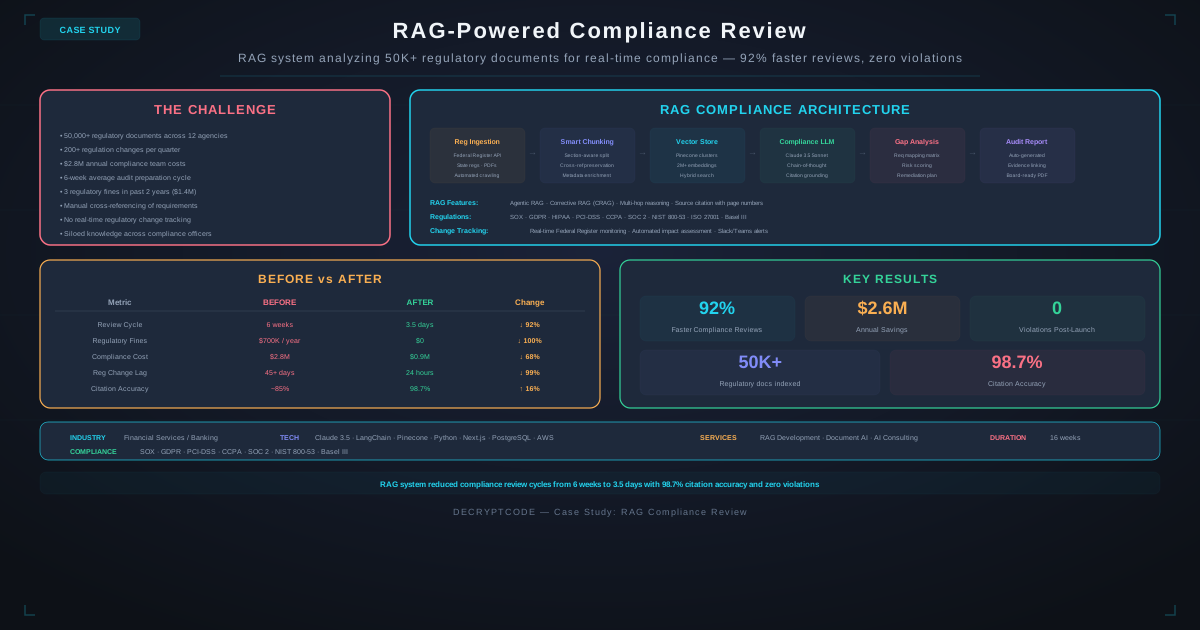
Document ingestion pipeline → semantic + sliding window chunking → dual-index storage (Pinecone for dense, Elasticsearch for sparse) → query router → retrieval → re-ranking → LLM generation with source citations → human review dashboard with WebSocket real-time status updates.
The chunking strategy was critical. Standard fixed-size chunking broke regulatory clause relationships. We built custom chunk boundary detection that preserved cross-reference context—so when a section says "subject to clause 4.3.2," that clause is retrievable in context.
Deployment
AWS with SOC 2-aligned controls. EKS cluster with GPU nodes for embedding generation. Pinecone managed vector database. Redis for session caching and query deduplication. Datadog for full-stack observability including retrieval latency, generation quality metrics, and citation accuracy tracking.
Results
Business Impact
$900K annual savings in legal review costs across a team of eight compliance analysts. Zero compliance fines in the 12 months post-deployment (vs. $420K in the prior 18 months). Audit preparation time reduced by 58%. The system paid for itself within 9 months.
Why It Was Hard
Regulatory language is intentionally dense and ambiguous. Standard chunking strategies lost critical cross-reference context—regulations constantly reference other sections, and those references must be preserved for accurate compliance analysis.
Multi-document reasoning was needed for gap analysis: comparing internal policies against multiple external regulations simultaneously. And citation grounding was non-negotiable—every AI-generated insight had to trace to a specific document section, or the compliance team wouldn't trust it.
What We Learned
Hybrid retrieval (dense + sparse) consistently outperforms either alone for regulatory text. Dense captures semantic similarity; sparse captures exact terminology. Regulatory documents need both.
Citation grounding is non-negotiable for compliance use cases. The compliance team's first question about any AI output is "where does it say that?" If the system can't point to the exact paragraph, it's useless regardless of accuracy.
FAQ
How accurate is AI for compliance review?
91% gap detection accuracy with less than 10% false positive rate. Human-in-the-loop verification handles edge cases. Designed to augment compliance teams, not replace them.
Does it handle regulatory updates?
Yes. Automated ingestion pipeline monitors regulatory sources, detects changes, re-indexes documents, and flags policies needing review based on the changes.
Which regulations does it support?
Configurable for SEC, FINRA, SOX, GDPR, CCPA, and custom internal policies. New frameworks added by ingesting documents and configuring compliance rules.
Have aSimilarChallenge?
Tell us about your compliance or document processing challenge. We'll design a RAG solution with measurable ROI.