Field Note · Architecture
MCP Goes Stateless: What the 2026 Spec Means for Enterprise AI Agents
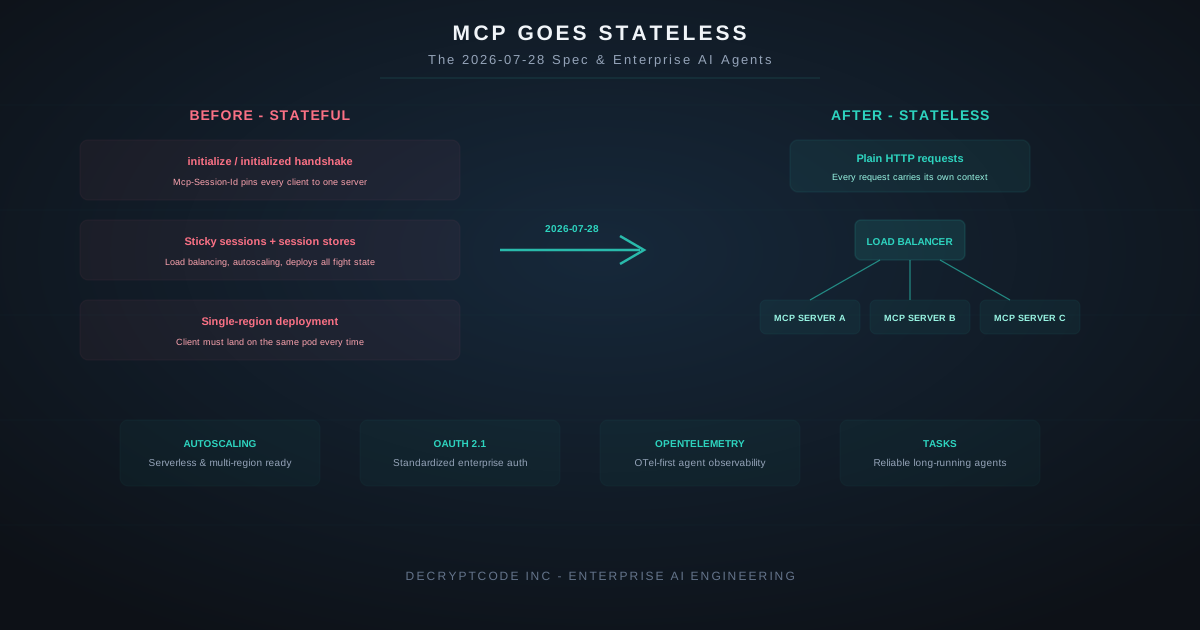
On July 28, 2026, the Model Context Protocol shipped its biggest revision since launch: the protocol core is now completely stateless. The handshake is gone, sessions are gone, and a remote MCP server is now a plain HTTP service you can load-balance, autoscale, and deploy serverless. Here's what changed, why it matters, and how to migrate.
What Shipped on July 28, 2026
The Model Context Protocol — the open standard that connects AI agents to tools, APIs, and data sources — shipped its 2026-07-28 specification, and it is the largest revision since Anthropic open-sourced the protocol in late 2024. The headline changes:
- Stateless protocol core: The
initialize / initializedhandshake and theMcp-Session-Idheader are removed entirely. Every request now carries its own context. - Standardized authorization: The spec explicitly aligns with OAuth 2.1 and OpenID Connect, replacing a patchwork of vendor-specific auth schemes.
- OpenTelemetry observability: The proprietary logging channel is replaced with OTel traces, metrics, and logs.
- Tasks extension: Contributed by AWS, Tasks brings first-class support for reliable, long-running agent work — no more hand-rolled polling loops.
All four Tier 1 SDKs (TypeScript, Python, Go, C#) shipped support the same day, and the ecosystem moved fast: FastMCP 4.0 launched alongside the spec, Azure App Service added native MCP endpoints, and Amazon Bedrock AgentCore ships the stateless core. The SDKs are now pulling close to half a billion downloads a month — this is no longer an experimental protocol.
Why Stateful MCP Didn't Scale
The original MCP design assumed a long-lived connection between one client and one server — reasonable for a desktop assistant talking to a local tool, painful for anything at enterprise scale. Statefulness leaked into every layer of infrastructure:
- Sticky sessions: Because the session lived on a specific server instance, load balancers had to pin each client to the same pod. One hot client could saturate a pod while others idled.
- Deploys drained slowly: Rolling out a new server version meant draining live sessions or dropping them mid-conversation.
- Autoscaling fought state: Scaling down killed sessions; scaling up didn't help clients already pinned elsewhere.
- Serverless was impractical: Functions that spin down between invocations can't hold a session, so an entire deployment class was effectively off the table.
- Multi-region was fragile: A client had to land in the same region — and on the same instance — every time.
Teams worked around this with external session stores and custom routing, which is exactly the kind of infrastructure toil a protocol should eliminate, not create.
The Stateless Core Explained
The 2026-07-28 spec solves this by moving all conversational state to the client side and making every server request self-contained. In practice:
- No handshake: A client can send its first tool call immediately. Capability discovery happens per-request, not per-session.
- No session ID: There is nothing to pin, replicate, or expire. Any server instance can answer any request.
- Context travels with the request: The information a server needs to fulfill a call arrives in that call.
What this looks like side by side
| Concern | Old spec (stateful) | 2026-07-28 spec (stateless) |
|---|---|---|
| Connection setup | initialize / initialized handshake | None — first request is a working request |
| Session tracking | Mcp-Session-Id header, server-side state | Removed — each request self-contained |
| Load balancing | Sticky sessions required | Round-robin just works |
| Serverless | Impractical | First-class (Cloud Run, Workers, Lambda) |
| Long-running work | Hand-rolled polling | Tasks extension |
| Observability | Proprietary logging channel | OpenTelemetry |
Interactive features like elicitation still work — they're layered on top of the stateless core rather than baked into transport, which is why platforms like Honeycomb (where agents now make nearly 20% of interactive queries) could adopt the new spec without losing functionality.
Deployment Wins: Load Balancing to Serverless
Once an MCP server is a stateless HTTP service, a decade of boring, battle-tested web infrastructure applies directly:
- Round-robin load balancing: No instance coordination, no session store to provision, no risk of a client landing on the wrong pod.
- Seamless autoscaling: Scale to zero at night, burst to hundreds of instances under load. Deploys don't drain sessions because there are none.
- Serverless deployment: Google Cloud Run, Cloudflare Workers, AWS Lambda, and Azure Container Apps all run MCP servers as ordinary workloads now.
- Global multi-region: Because every request carries its own context, you can put MCP servers behind a global load balancer and serve each request from the nearest region.
This is the same architectural shift REST went through relative to stateful RPC — and it's why Google, which co-founded the MCP Transports Working Group to drive this change, describes the release as making "load balancing boring." Boring is exactly what you want from the infrastructure under your agents.
Observability Moves to OpenTelemetry
The old spec had a proprietary logging channel that only MCP-aware tooling could read. The new spec replaces it with OpenTelemetry — the same standard the rest of your stack already emits. That means:
- Unified traces: An agent's tool call can be traced from the LLM decision, through the MCP gateway, into the downstream API, and back — on one timeline, in your existing observability platform.
- Standard metrics: Latency, error rate, and throughput per tool and per server, without custom exporters.
- Correlated debugging: When an agent misbehaves in production, you can answer "which tool call was slow?" and "which downstream service degraded?" with the tooling your SRE team already knows.
A simpler architecture does not mean less to monitor. Agentic systems fail in subtle ways — a tool that silently degrades, an agent that starts calling tools it rarely used. OTel-first telemetry is what makes those failures visible, and it pairs directly with the evaluation and guardrails layer every production agent needs.
Security and Governance: The Real Bottleneck
Here's the uncomfortable industry statistic: while roughly 41% of software-industry technical leaders report some production MCP use, only about 8.5% of MCP servers implement the protocol's mandatory OAuth 2.1 flow. The protocol matured faster than the organizations deploying it.
The emerging enterprise pattern is a centralized MCP gateway in front of every server, handling:
- Authentication: OAuth 2.1 / OpenID Connect enforced at the gateway, so individual servers can't skip it.
- Audit logging: Every tool call recorded — who, what, when, with what parameters — for compliance and incident response.
- Policy enforcement: Tool allowlists per agent, rate limits, and value thresholds. AWS's temporal policies in Bedrock AgentCore go further, constraining agent action sequences to limit cumulative risk.
- Bounded autonomy: High-stakes actions still route through human-in-the-loop approval, regardless of how capable the agent is.
Stateless architecture actually helps here — there's no session to hijack and no session store to breach — but it doesn't replace agent-layer defenses. Prompt injection, data exfiltration, and privilege escalation all still apply; our AI agent security guide covers the defense-in-depth playbook.
Enterprise Adoption: Hype vs. Reality
The vendor benchmarks are impressive: Bloomberg's 9,500-person engineering org cut agent-context configuration from weeks to minutes with MCP; JPMorgan Chase has disclosed over 450 agent use cases in production. But those are Tier 1 institutions with dedicated AI infrastructure teams.
For the median organization, the honest picture in August 2026 is:
- Adoption intent is high, production reality is thinner. Most deployments are still team-level pilots, not governed enterprise platforms.
- Legacy integration is the grind. The protocol connects agents to tools cleanly, but the tools themselves — ERP systems, internal databases, decades-old APIs — still need adapters, data contracts, and access controls.
- Regulation is arriving. The EU AI Act and sector rules (HIPAA, SOC 2, fair-lending) increasingly require documented agent behavior, which pushes audit logging and evaluation from nice-to-have to mandatory.
The strategic takeaway: agent capability is no longer the bottleneck. The differentiator is the unglamorous engineering around it — governance, evaluation, observability, and integration. That's precisely where an experienced AI agent development partner compresses the timeline.
Migration Checklist for Your MCP Servers
If you're running MCP servers built on the older spec, the migration is tractable — most teams complete it in days, not months:
- Upgrade SDKs first. All Tier 1 SDKs (TypeScript, Python, Go, C#) support the new spec; FastMCP 4.0 does too. Most handshake removal happens inside the SDK.
- Find your session dependencies. Grep for anything keyed on
Mcp-Session-Idor stored per-connection. Move that state to the client, the request context, or an external store keyed on something durable (user ID, tenant ID). - Replace polling with Tasks. Long-running operations should move to the Tasks extension rather than custom job-status endpoints.
- Switch telemetry to OpenTelemetry. Wire OTel exporters into your existing observability platform and delete the proprietary logging shims.
- Fix auth before you scale. Implement OAuth 2.1 properly — or put a gateway in front that does. Don't join the 91.5% of servers that skip it.
- Then simplify infrastructure. Remove sticky-session config, session stores, and drain logic. Re-platform to serverless or multi-region if the economics make sense.
The order matters: teams that scale out before fixing auth just multiply their attack surface.
Frequently Asked Questions
What changed in the MCP 2026-07-28 specification?
The 2026-07-28 release makes the Model Context Protocol core stateless. The initialize/initialized handshake and the Mcp-Session-Id header were removed entirely, so a remote MCP server is now a plain stateless HTTP service. It also standardizes OAuth 2.1 authorization, adopts OpenTelemetry for observability, and adds a Tasks extension for reliable long-running agent work.
Do I need to rewrite my existing MCP servers?
Not from scratch. All four Tier 1 SDKs (TypeScript, Python, Go, C#) shipped support for the new spec on release day, and most servers built on FastMCP or the official SDKs migrate by upgrading the SDK and removing session-dependent logic. Servers that stored per-session state need that state moved to an external store or passed in request context.
Is MCP ready for enterprise production use?
The protocol is ready; most organizations' governance is not. Around 41% of software-industry technical leaders report some production MCP use, but only a small fraction run governed, enterprise-wide deployments, and few servers implement the mandatory OAuth 2.1 flow correctly. A centralized MCP gateway handling authentication, audit logging, and policy enforcement is the emerging best practice.
Does stateless MCP make AI agents more secure?
It helps but doesn't solve security by itself. Stateless servers shrink the attack surface (no session hijacking, no session stores to breach) and the spec now aligns authorization with OAuth 2.1 and OpenID Connect. You still need prompt injection defenses, least-privilege tool scopes, human-in-the-loop gates, and full audit logging at the agent layer.
Production AI Agents, Built Right
We design MCP-based agent architectures with governance, evaluation, and observability built in — from pilot to enterprise scale.
Start a Project